Category: Managing Stress

  • Why Am I So Stressed? A 3-Minute Nervous System Reset That Helps

    Why Am I So Stressed? A 3-Minute Nervous System Reset That Helps

    You wake up already tense. Your jaw is clenched before breakfast. The smallest thing sets you off. You keep asking yourself: why am I so stressed? Nothing catastrophic is happening. Life is busy, sure, but it has always been busy. So why does your body feel like it is running from something?

    You are not broken, and you are not overreacting. Stress is a physical state before it is a mental one. Once your nervous system learns to stay alert, it keeps looking for threats even when the room is quiet. The good news: you can teach it to power down again. The reset below takes about three minutes and works with your body, not against it.

    Why am I so stressed when nothing major is wrong?

    Your stress response is built for short bursts. A threat appears, your body floods with adrenaline and cortisol, you deal with it, and then you recover. The problem is modern life keeps the alert system active in small, repeated doses: notifications, deadlines, traffic, news, financial pressure, conflict, poor sleep, caffeine, and even constant background noise.

    Each dose is small. But when they stack up without recovery, your nervous system starts to treat alert as normal. That is when you feel stressed without a clear reason. Harvard Health Publishing describes the stress response as a survival mechanism meant for brief activation, not the chronic background hum many people live with today.

    The feeling of being stressed all the time is usually your body saying: I have not had a clear safety signal in a while.

    Common hidden reasons you feel so stressed

    Sometimes the cause is obvious: a deadline, a health scare, money pressure. Often it is a collection of smaller things your brain is processing as threats:

    • Sleep debt. Even one rough night raises cortisol the next day. Several rough nights in a row make everything feel harder.
    • Constant input. Checking email, news, and social feeds keeps your threat-detection system scanning.
    • No clear off-ramp. Work bleeds into evenings. There is no signal that tells your body the danger is over.
    • Caffeine and alcohol. Coffee amps the alert system. Alcohol can disrupt sleep and recovery.
    • Unresolved micro-conflicts. A difficult conversation you keep replaying keeps stress hormones circulating.
    • Low movement. The body clears stress hormones through movement. Sedentary days mean the chemistry stays in your system.

    You do not need to fix all of these at once. But naming them helps you stop blaming yourself for a biological response that has a real cause.

    A 3-minute reset for when you feel stressed for no reason

    Do this wherever you are. The goal is not to solve every problem. It is to send your body a clear safety signal so your nervous system can shift out of alert mode.

    Minute 1: Physiological sigh

    1. Inhale through your nose.
    2. Take a second, shorter inhale through your nose to top up your lungs.
    3. Exhale slowly through your mouth until your lungs feel empty.
    4. Repeat three to five times.

    The double inhale followed by a long exhale is one of the fastest ways to reduce arousal. Stanford neuroscientist Andrew Huberman has described the physiological sigh as a rapid, voluntary way to calm the nervous system and reset the breath.

    Minute 2: Ground through your senses

    Place both feet flat on the floor. Feel the weight of your body in the chair. Then run through the 5-4-3-2-1 anchor: five things you can see, four you can feel, three you can hear, two you can smell, and one you can taste.

    This pulls your brain out of imagined threats and into present-moment information that is usually neutral or safe.

    Minute 3: Name it and narrow it

    Say silently: “This is stress. I do not have to solve everything right now.”

    Then write one sentence: what is the one thing actually bothering you most, and what is the smallest next step? Naming the state and narrowing the problem interrupts the loop that keeps stress spinning.

    How to lower your stress baseline so you ask “why am I so stressed” less often

    The reset handles the spike. To need it less, add small recovery signals into your day:

    • One long exhale before you check your phone. Start the morning by calming your nervous system before the world gets in.
    • A five-minute movement break. Walk, stretch, shake your arms. The body clears stress hormones through motion.
    • A clear end to the workday. Write tomorrow’s top three tasks, close the laptop, and say out loud: “Work is done.”
    • Protect your sleep. Keep caffeine to the morning and wind down input an hour before bed.
    • Schedule one real pause. Even five minutes of stillness, without input, gives your nervous system a chance to drop.

    These are not luxuries. They are the signals your body uses to know it is safe to stop defending itself.

    When stress is a message, not a malfunction

    Sometimes the answer to “why am I so stressed” is that something in your life genuinely needs attention: a boundary that is missing, a job that is wrong for you, a relationship that drains you, or a health issue you have been ignoring.

    Body-based resets help you think clearly enough to notice the message. They do not replace action. If the same stress keeps returning after you calm your body, treat it as data. What is it pointing to? What is one small change you could make this week?

    When to get extra help

    Body-based resets are powerful, but they are not a replacement for professional care when stress has become chronic or overwhelming. Consider talking to a doctor, therapist, or counselor if you feel extremely stressed most days for more than two weeks, if it is affecting your sleep, appetite, relationships, or work, or if you are experiencing panic, depression, or thoughts of self-harm. The National Institute of Mental Health has clear guidance on anxiety disorders and when to seek support.

    Try the free 3-Minute Calm Reset

    If you want a simple, guided version of the same body-based techniques, grab the free 3-Minute Calm Reset. You get it straight away with just your email. No app. No subscription. Just a practical reset you can use the next time you catch yourself wondering why you are so stressed.

    Related reads

    Sources

  • How to Choose an Online Stress Course That Actually Retrains Your Nervous System

    How to Choose an Online Stress Course That Actually Retrains Your Nervous System

    There are dozens of online stress courses. Most promise calm. Few deliver it in a way your body can actually use.

    The problem is not motivation. It is that many courses are built around advice — breathe more, think positive, manage your time — while stress lives deeper than thoughts. If your chest gets tight, your mind races at 3 a.m., or you feel wired for no clear reason, you need a course that teaches your nervous system to power down, not just your calendar.

    Below is what to look for when you choose an online stress course, what to ignore, and how to tell whether a program is likely to help before you pay.

    What an online stress course should actually do

    Stress is a body state that becomes a habit. The right course reverses the habit.

    It should teach you to:

    • Downshift on purpose. Not wait for stress to pass, but actively move your body from alert to calm.
    • Use techniques that work even when your mind is noisy. Breathing and grounding beat willpower because they operate below the level of thought.
    • Build calm as a baseline. A few minutes a day should lower your default level of tension, not just rescue you in emergencies.
    • Progress in small, clear steps. One practice at a time, so the habit sticks.

    7 signs an online stress course is worth taking

    1. It is body-based, not insight-only. Look for practices like the physiological sigh, slow exhale breathing, grounding, progressive muscle relaxation, and vagus-nerve exercises. These change the body first; the mind follows.
    2. The daily practice fits into real life. A course that demands 45 minutes a day will not survive a busy week. Five to ten minutes is enough if the technique is right.
    3. It explains the why. When you understand how your nervous system works, you trust the process and keep going.
    4. It targets your baseline, not just panic moments. Emergency calm-downs are useful, but lasting change happens when your resting state drops a few notches.
    5. It includes a money-back guarantee. The creator should carry some of the risk, not all of it.
    6. It is simple enough to do when tired. If a technique requires perfect focus or a quiet room, it will not help at midnight.
    7. It has a clear structure. Day one to day seven should build on each other, not feel like a random playlist of tips.

    Red flags to skip

    • “One weird trick” promises. Nervous-system rewiring takes repetition, not a single hack.
    • Hours of video you will never finish. Longer content is not more effective.
    • Vague language with no specific practice. Inspiration without a body-based tool rarely changes anything.
    • No refund policy. If the creator will not let you test it, that says something.
    • It asks you to believe first, feel later. You should feel a shift in your body within the first session.

    How to match a course to your specific stress pattern

    Different people experience stress differently. The best online stress course for you depends on what shows up most:

    • Racing mind, 3 a.m. wake-ups: Look for grounding, physiological sigh, and stimulus-control sleep guidance.
    • Chest tightness, shallow breathing, panic-like surges: Look for slow exhale techniques and breath-focus practices.
    • Jaw tension, neck pain, body bracing: Look for progressive relaxation and body-scan release.
    • Overwhelm, can’t switch off after work: Look for nervous-system transition rituals and boundary practices.
    • Social or performance anxiety: Look for pre-event resets and exposure-style small steps.

    Why our 7-Day Stress Reset is built around these criteria

    Our 7-Day Stress Reset is designed for people who want a practical system, not another course to collect dust. It uses body-based techniques — the physiological sigh, grounding, slow exhales, and nervous-system resets — in short daily sessions. The goal is to teach your body that calm is safe, so calm becomes easier over time.

    It is $97, with a 30-day money-back guarantee. You can go through it in a week and still be using the practices a year later.

    Not ready for a course? Start with the free reset

    If you want to test whether this approach works for your body before buying, start with the free 3-Minute Calm Reset. It covers the same physiological sigh and grounding techniques, sent straight to your email. No app. No subscription. Just a tool you can use the next time stress shows up.

    Related reads

    Sources

    • Harvard Health Publishing, Understanding the stress response.
    • American Psychological Association, Stress.
    • Huberman Lab, Stanford School of Medicine, discussion of the physiological sigh and rapid stress reduction.
    • Goyal, M., et al. (2014). Meditation programs for psychological stress and well-being: a systematic review and meta-analysis. JAMA Internal Medicine, 174(3), 357-368.
  • What Is the Best Stress Reset Course? A Simple Buyer’s Guide

    What Is the Best Stress Reset Course? A Simple Buyer’s Guide

    You have tried the breathing apps, the meditation playlists, the “just relax” advice. They help for a few minutes. Then the tight chest, the racing mind, and the 3 a.m. wake-ups come back.

    A stress reset course is different. It is not a collection of tips. It is a short, structured program that retrains your nervous system to power down, so calm stops being a lucky break and starts being your baseline.

    The best stress reset course does this in minutes a day, uses body-based techniques you can feel working, and gives you a way to test it without risk. Below is what to look for — and what to ignore — when you choose one.

    What a stress reset course should actually do

    Stress lives in the body before it shows up in your thoughts. Your nervous system learns to stay alert, and after enough repetition, alert becomes normal. A real reset course reverses that learning.

    It should:

    • Teach your body to downshift. Not just distract you, but show your nervous system how to move from alert to calm on purpose.
    • Take minutes, not hours. A course you cannot finish is not a course. Daily practice should fit into a busy life.
    • Stack small wins. Day-by-day progress, not a single miracle session.
    • Include a money-back guarantee. If the creator trusts the method, they should let you prove it to yourself.

    5 signs a stress reset course is worth your time

    1. It is built around physiology, not willpower. Look for techniques like the physiological sigh, slow exhales, grounding, and progressive relaxation — things that work even when your mind is still racing.
    2. It targets your baseline, not just emergencies. Emergency calm-downs are useful, but lasting change happens when your default state drops a few notches.
    3. It is simple enough to do tired. If the technique requires perfect focus or a quiet hour, it will not survive real life.
    4. It explains why it works. When you understand the nervous-system logic, you trust the process and keep going.
    5. It does not demand belief first. You should not have to “manifest” calm. You should feel it in your body on day one.

    Red flags to avoid

    • “One weird trick” promises. Stress rewiring takes repetition, not a single hack.
    • Hours of content you will never finish. Longer is not better.
    • Vague language with no clear practice. Insight without action does not change your body.
    • No refund policy. A course that cannot offer a guarantee is asking you to carry all the risk.

    One course built around these criteria

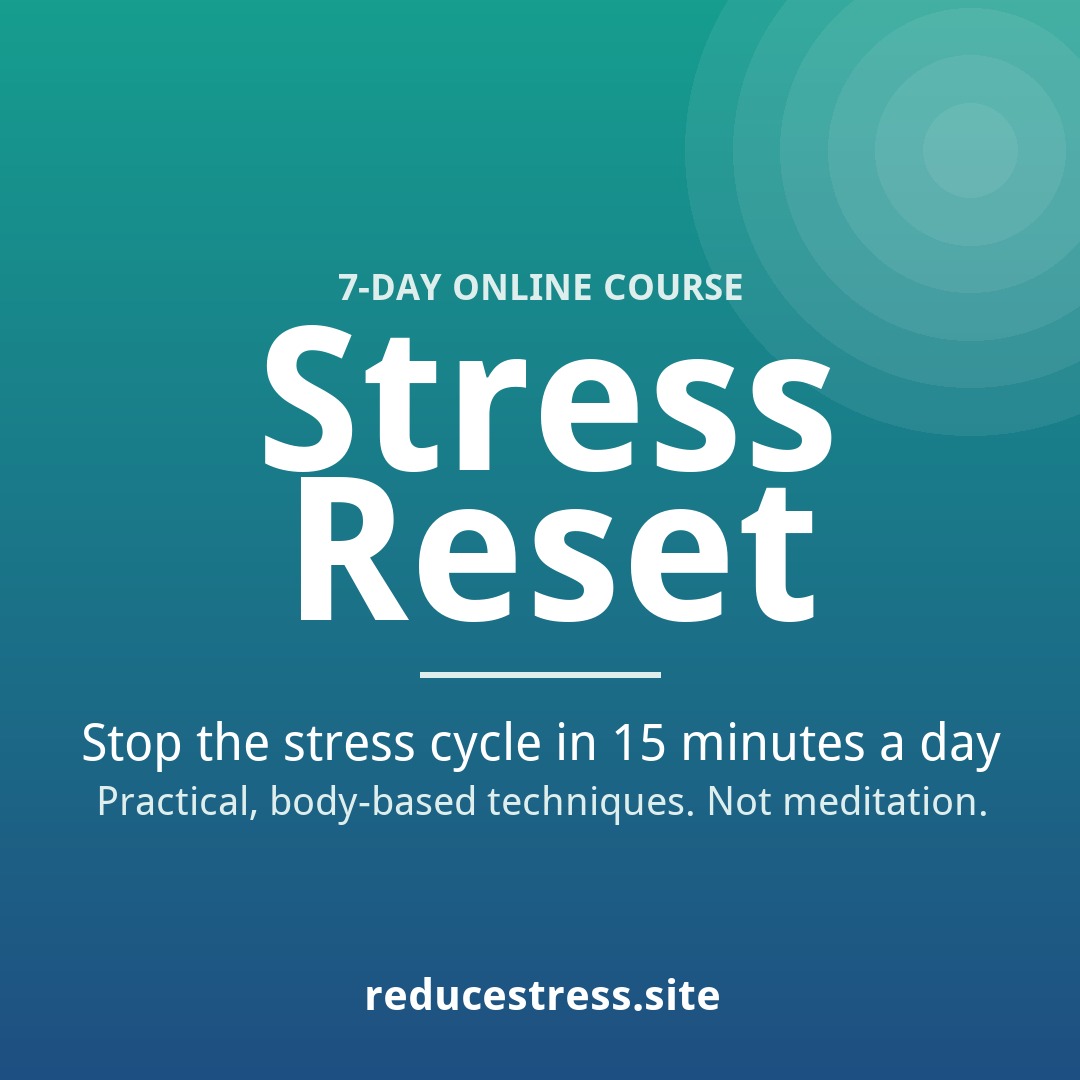
    7-Day Stress Reset course cover showing daily body-based stress relief practices

    Our 7-Day Stress Reset is built for exactly this: one small body-based practice each day, minutes at a time, designed to teach your nervous system that calm is safe. It is $97, with a 30-day money-back guarantee.

    It is not for people who want another ebook to collect dust. It is for people who want a practical system they can use tonight and still be using a year from now.

    Try the free reset first

    If you are not ready for a course, start with the 3-Minute Calm Reset. It uses the same physiological sigh and grounding techniques, delivered to your email for instant access. No app. No subscription. Just a tool you can use the next time stress shows up.

    Related reads

    Sources

    • Harvard Health Publishing, Understanding the stress response.
    • American Psychological Association, Stress.
    • Huberman Lab, Stanford School of Medicine, discussion of the physiological sigh and rapid stress reduction.
  • Can’t Sleep Because of Stress and Anxiety? A 3-Minute Body Reset for Rest

    Can’t Sleep Because of Stress and Anxiety? A 3-Minute Body Reset for Rest

    It’s 2 a.m. Your body is exhausted, but your mind is wide awake. Every time you start to drift off, your brain serves up tomorrow’s problems, today’s mistakes, or a vague sense that something is wrong. If you can’t sleep because of stress and anxiety, you are not broken ├óΓé¼ΓÇ¥ your nervous system is still on guard, and sleep is a permission it hasn’t given your body yet.

    The fastest way back to rest is not to think harder. It is to send your body a clear safety signal. The reset below takes about three minutes and works with your nervous system, not against it. You can use it tonight, and again whenever stress tries to keep you awake. If your mind races the moment your head hits the pillow, the related guide on stress keeps me awake at night covers the same loop from the bedtime side.

    Why stress and anxiety hijack sleep

    Sleep is not something you force. It is something your body allows when it feels safe enough to let go. Stress does the opposite. When your brain senses pressure — real or imagined — it releases cortisol and adrenaline. Your heart beats faster, your muscles tense, your breathing becomes shallow, and your mind narrows its focus onto potential threats.

    That state is useful during the day. It is terrible at night. Even after the original stressor is gone, your body can stay locked in mild alert mode. That is why you can feel exhausted and wired at the same time, why your chest feels tight in bed, and why the smallest thought sets off a mental spiral.

    Research from the Sleep Foundation explains the bidirectional link between stress and insomnia: stress disrupts sleep, and poor sleep lowers the threshold for stress the next day. Breaking that loop starts with calming the body, not solving every problem in your head.

    A 3-minute reset when you can’t sleep because of stress and anxiety

    Do this lying down or sitting on the edge of the bed. The goal is not to fall asleep instantly. The goal is to move your nervous system far enough toward rest that sleep can take over.

    Minute 1: Physiological sigh

    1. Inhale through your nose.
    2. Take a second, shorter inhale through your nose to top up your lungs.
    3. Exhale slowly through your mouth until your lungs feel empty.
    4. Repeat three to five times.

    The double inhale followed by a long exhale is one of the fastest ways to reduce arousal. Stanford neuroscientist Andrew Huberman has described the physiological sigh as a rapid, voluntary way to calm the nervous system and reset the breath.

    Minute 2: Ground through weight

    Feel the back of your body pressing into the mattress or chair. Notice the weight of your legs, your hips, your shoulders, and the back of your head. Let each area soften by a single degree on every exhale.

    If your mind is racing, add one simple sensory anchor: name five things you can physically feel right now. The blanket against your ankle. The pillow under your cheek. The air on your face. This pulls attention out of imagined threats and into the present moment.

    Minute 3: Name the state and park the thought

    Say silently: “This is stress. I don’t have to solve anything right now.”

    Then pick the one thought looping loudest and give it a temporary place. You can write it on a notepad by the bed, set a reminder for morning, or simply say: “I’ll handle you at 8 a.m.”

    Naming the emotion and parking the task creates separation. You are no longer inside the spiral; you are observing it. That gap is where rest begins.

    What not to do when anxiety keeps you awake

    Some common reactions make the problem worse:

    • Lying in bed trying harder to sleep. This creates performance anxiety around sleep itself. If you are not drifting after fifteen or twenty minutes, get up and do something low-stimulus in dim light until your eyelids feel heavy.
    • Checking your phone. The light and input tell your brain it is still daytime. Keep screens out of bed.
    • Replaying the day. Analysis belongs to the morning. At night it is just rumination wearing a disguise.
    • Clock-watching. Calculating how little sleep you will get adds another stressor. Turn the clock away.

    How to lower the chance it happens again tomorrow

    A reset handles the spike. To stop stress from stealing sleep night after night, you need a few daily signals that teach your body activation is temporary.

    • Close the workday on purpose. Write tomorrow’s top three priorities, close the laptop, and say out loud: “Work is done.” Your brain needs an off-ramp or it will keep processing into the night.
    • Cut evening input an hour before bed. No news, no work email, no financial apps. Give your nervous system a wind-down instead of more data to process.
    • Move your body during the day. The body clears stress hormones through movement. Even a twenty-minute walk helps.
    • Keep caffeine to the morning. Caffeine has a long half-life and can keep your system alert hours later.
    • Go to bed and wake at the same time. Predictability calms the nervous system.

    When sleep trouble is more than a rough patch

    Body-based resets help, but they are not a replacement for professional support if stress, anxiety, or insomnia have become chronic. Consider talking to a doctor, therapist, or sleep specialist if:

    • You can’t sleep because of stress and anxiety at least three nights a week for more than a month.
    • Sleep problems are affecting your mood, work, relationships, or safety.
    • You have panic attacks, depression, or thoughts of self-harm.

    The National Institute of Mental Health has clear guidance on anxiety disorders and when to seek help. The Sleep Foundation also offers resources on stress and insomnia. You do not have to handle it alone.

    Try the guided 3-Minute Calm Reset

    If you want a simple, step-by-step version of the same body-based reset, our free 3-Minute Calm Reset walks you through the physiological sigh and a grounding exercise designed for moments when you can’t sleep because of stress and anxiety.

    You get it straight away with just your email — no app, no subscription, no noise. Use it in bed, use it before a hard conversation, or use it when you wake up wired at 3 a.m.

    Related reads

    Sources

  • How to Calm Down Quickly When Stressed: A 3-Minute Reset That Actually Works

    How to Calm Down Quickly When Stressed: A 3-Minute Reset That Actually Works

    Your heart is racing. Your shoulders are somewhere near your ears. Maybe someone said one more thing, your phone buzzed, or a deadline just moved up. You do not need a meditation app, a walk, or a weekend away. You need to calm down quickly ΓÇö right now.

    Here is a body-based reset that takes about three minutes. It works because stress is a physical state before it is a mental one. Change the body first, and the mind follows.

    Why ΓÇ£just relaxΓÇ¥ rarely works

    When stress hits, your brain flips on the alert system. Cortisol and adrenaline spike, your heart rate climbs, your breathing gets shallow, and your muscles tense. That response is useful if you are actually in danger. It is useless when it fires because of an email, a traffic jam, or a difficult conversation.

    The problem is that your body does not respond to logic in that state. Telling yourself to calm down is like telling a fire to stop being hot. You have to work through the body.

    Harvard Health Publishing describes the stress response as a survival mechanism built for short bursts, not for the continuous background noise of modern life. The American Psychological Association notes that repeated activation without recovery can leave you feeling wired, tired, and reactive.

    How to calm down quickly when stressed: the 3-minute reset

    Do this wherever you are ΓÇö at your desk, in your car, in a bathroom, in bed. No one has to know you are doing it.

    Minute 1: The physiological sigh

    1. Inhale through your nose.
    2. Take a second, shorter inhale through your nose to top up your lungs.
    3. Exhale slowly through your mouth until your lungs feel empty.
    4. Repeat three to five times.

    The double inhale followed by a long exhale is one of the fastest ways to lower physiological arousal. Stanford neuroscientist Andrew Huberman has described the physiological sigh as a rapid, voluntary way to calm the nervous system.

    Minute 2: Ground through your feet

    Place both feet flat on the floor. Press them down gently. Feel the weight of your body in the chair. Notice the contact between your hands and your legs or the surface in front of you.

    If your mind is still racing, add a simple sensory anchor. Name five things you can see, four you can feel, three you can hear, two you can smell, and one you can taste. We have a full walkthrough of this in our guide to 5-4-3-2-1 grounding for anxiety, but the short version is enough here.

    Minute 3: Name it and narrow it

    Say silently to yourself: ΓÇ£This is stress. I do not have to solve everything right now. I only have to handle the next minute.ΓÇ¥

    Then write one sentence on your phone or a scrap of paper:

    • What exactly is bothering me?
    • What is the one smallest thing I can do next?

    Naming the state and narrowing the problem interrupts the loop that keeps stress spinning.

    Why this works so fast

    Longer exhales activate the vagus nerve, the main pathway of your parasympathetic nervous system ΓÇö the bodyΓÇÖs ΓÇ£rest and digestΓÇ¥ mode. When the vagus nerve is active, your heart rate drops, your muscles soften, and your brain gets the message that the danger has passed.

    Grounding adds a second safety signal by pulling your attention out of imagined threats and into real, present-moment sensation. The brain dump removes the mental load that was keeping the alert system active.

    A 2014 meta-analysis in JAMA Internal Medicine found that mindfulness-based programs showed moderate evidence of improving anxiety and stress-related symptoms. You do not need twenty minutes. Three honest minutes is enough to start the shift.

    What not to do when you need to calm down fast

    Some reactions feel helpful in the moment but actually keep the stress response alive:

    • Holding your breath. Shallow or held breathing signals danger to the brain. Keep the exhale long and slow.
    • Doom-scrolling. More input, more cortisol. Put the phone down until your body has shifted.
    • Caffeine on top of stress. It amplifies the same arousal you are trying to calm.
    • Trying to think your way out. Your prefrontal cortex is not in charge when stress is high. Calm the body first, then think.

    How to stay calm after the moment passes

    The reset handles the spike. To lower your baseline so you do not have to reset as often, add small recovery signals into your day:

    • One long exhale before you check your phone. Set the tone for your nervous system before the world gets in.
    • A five-minute movement break. The body clears stress hormones through movement, not through sitting still.
    • A clear end to the workday. Write tomorrowΓÇÖs top three tasks, close the laptop, and say out loud: ΓÇ£Work is done.ΓÇ¥ Your brain needs an off-ramp.
    • Protect sleep. Even one rough night raises stress the next day. See our article on feeling extremely stressed all the time for more on breaking the loop.

    When stress is more than a moment

    Body-based resets are powerful, but they are not a replacement for help when stress has become chronic or overwhelming. Consider talking to a doctor, therapist, or counselor if:

    • You feel extremely stressed most days for more than two weeks.
    • Stress is affecting your sleep, appetite, relationships, or ability to work.
    • You feel panic, depression, or have thoughts of self-harm.

    The National Institute of Mental Health has clear guidance on anxiety disorders and when to seek professional support.

    Try the guided reset

    If you want a simple sequence that walks you through the same body-based techniques, our free 3-Minute Calm Reset is sent to your email. No app. No subscription. Just a practical reset you can use the next time you need to calm down quickly when stressed.

    Related reads

    Sources

    • Harvard Health Publishing, Understanding the stress response.
    • American Psychological Association, Stress.
    • Goyal, M., et al. (2014). Meditation programs for psychological stress and well-being: a systematic review and meta-analysis. JAMA Internal Medicine, 174(3), 357-368.
    • Huberman Lab, Stanford School of Medicine, discussion of the physiological sigh and rapid stress reduction.
    • National Institute of Mental Health, Anxiety Disorders.
  • How to Calm Down When Anxious and Stressed: A 5-Minute Reset

    How to Calm Down When Anxious and Stressed: A 5-Minute Reset

    Your heart is racing. Your shoulders are up by your ears. Your mind is either sprinting through every possible disaster or stuck on one loop you can’t escape. If you want to know how to calm down when anxious and stressed, the fastest path is not to reason yourself out of it. It is to change your body state first, then let your mind follow.

    Stress and anxiety are body events before they are thoughts. When your nervous system senses threat — real or imagined — it floods your body with adrenaline and cortisol. Your breathing gets shallow. Your muscles tense. Your digestion slows. This is useful if you are in real danger. It is exhausting when the danger is a text message, a deadline, or a worry about tomorrow.

    Below is a simple 5-minute reset that works with your nervous system, not against it. No meditation app required. No need to “clear your mind.” Just five minutes of body-based actions that signal safety.

    The 5-minute anxious-and-stressed reset

    Do this sitting, standing, or lying down. The goal is not perfection. The goal is to shift your state a few degrees calmer than where you started.

    Minute 1: Feel your feet on the floor

    Look down or close your eyes. Notice the soles of your feet pressing into the ground. Wiggle your toes once. Let your weight sink into the chair or floor beneath you.

    This sounds too simple to matter. It is not. Anxiety pulls you up into your head. Bringing attention to your feet pulls you back into your body and into the present moment.

    Minutes 2–3: Slow your exhale

    Breathe in through your nose for a count of four. Exhale through your mouth for a count of six. Do this six to eight times.

    Lengthening the exhale activates the vagus nerve, the main channel of your parasympathetic nervous system — your body’s “rest and digest” mode. You are not trying to force calm. You are giving your body the mechanical signal that it is safe to relax.

    Minute 4: Name what is happening

    Say to yourself, quietly or out loud: “I am anxious right now. This is a feeling, not a fact. It will pass.”

    Naming the emotion reduces its intensity. Research from the UCLA Brain Mapping Center found that labeling feelings — a process called affect labeling — decreased activity in the amygdala, the brain’s threat detector. You do not have to believe the worst thoughts. You just have to name the state.

    Minute 5: Release one tight muscle group

    Pick the place that holds your stress: jaw, shoulders, fists, or stomach. Tense it for five seconds, then let it go completely. Do it twice.

    Progressive muscle relaxation works because it makes you conscious of the tension you have been carrying automatically. Once you feel the contrast between tight and loose, your body has a reference point for calm.

    Why this works when “just calm down” does not

    Telling yourself to calm down usually makes things worse. It adds pressure: why can’t I calm down? The reset above skips the mental argument and goes straight to the physiology.

    When you are anxious and stressed, your prefrontal cortex — the rational, planning part of your brain — is partly offline. You cannot think your way out because your brain is in protection mode. But you can breathe, ground, name, and release. Those actions do not require belief. They require doing.

    What to do if anxiety spikes in public

    You do not need a private room to reset. Try this discreet version:

    • Press both feet firmly into the floor.
    • Take three slow exhales through your nose.
    • Look around and name five colors you can see.
    • Unclench your jaw and drop your shoulders.

    No one around you will notice. Your nervous system will.

    How to lower your baseline so anxiety spikes less often

    The reset handles the moment. To make anxious moments less frequent, change the baseline your nervous system operates from:

    • Move your body every day. A 10-minute walk lowers stress hormones and burns off the physical residue of anxiety. You do not need a gym.
    • Cut the evening input. News, work email, and financial apps in the hour before bed keep your threat system active. Give your brain an off-ramp.
    • Eat regularly. Blood sugar crashes feel like anxiety. Protein and complex carbs at steady intervals help.
    • Limit caffeine after midday. Caffeine keeps your body in a low-grade alert state that stacks on top of stress.
    • Get one small win before noon. Anxiety feeds on the feeling that life is out of control. One completed task — even tiny — gives your brain evidence that you are handling things.

    When to get extra help

    Self-help techniques are powerful, but they are not a substitute for support when anxiety or stress has become chronic. Talk to a doctor, therapist, or counselor if:

    • Anxiety or stress is making it hard to work, sleep, or maintain relationships most days.
    • You have panic attacks, chest pain, or feel like something terrible is about to happen.
    • You feel depressed, hopeless, or have thoughts of self-harm.

    The National Institute of Mental Health has clear guidance on anxiety disorders and when to seek help. Getting support is not weakness. It is the smartest move you can make.

    Want the fastest version? Try the 3-Minute Calm Reset

    If you want a guided reset that walks you through the same body-based steps, the free 3-Minute Calm Reset is sent to your email. No app. No subscription. Just a practical tool you can use the next time anxiety and stress show up together.

    Related reads

    Sources

    • National Institute of Mental Health, Anxiety Disorders.
    • UCLA Semel Institute for Neuroscience and Human Behavior, research on affect labeling and amygdala activity.
    • Harvard Health Publishing, Understanding the stress response.
    • Huberman Lab, Stanford School of Medicine, discussion of breathing patterns and vagus nerve activation.

    Related: How to Calm Down Quickly When Stressed: A 3-Minute Reset.

  • Anxiety, Fear of Failure, and Creativity: How to Calm the Mind That Reviews Itself

    Anxiety, Fear of Failure, and Creativity: How to Calm the Mind That Reviews Itself

    You sit down to make something — a sentence, a sketch, a pitch, a plan — and before your hand even moves, your mind starts grading it.

    *This won’t be good enough. They’ll see through it. Why did you think you could do this?*

    That loop is not a lack of creativity. It is anxiety doing quality control on an idea that hasn’t been born yet. And it is exhausting.

    The good news: you can interrupt it. Not by forcing more confidence, but by teaching your nervous system that creation is safe even when the outcome is uncertain.

    Why anxiety and creativity feel like enemies

    Creativity needs open space. It needs mistakes, dead ends, and the willingness to look foolish for a moment. Anxiety does the opposite — it scans for threat and tries to eliminate risk before anything happens.

    When the two collide, you get a strange state: mentally busy, emotionally tight, and creatively frozen. You are working hard, but nothing is moving forward. Psychologists sometimes call this **performance anxiety** or **creative block**, but at the body level it is simpler: your threat system is running while your play-and-explore system is trying to start.

    A few signs this is happening:

  • You rewrite the same sentence ten times before the rest of the page exists.
  • You research endlessly but never begin.
  • You compare your raw draft to someone else’s finished work.
  • You feel sick or tense right before sharing anything.
  • You abandon projects the moment they feel imperfect.
  • If that sounds familiar, you are not broken. You are a human with a vigilant brain trying to protect you from rejection, shame, or failure.

    The real fear is not failure — it is what failure means

    Most people who fear failure are not afraid of the failure itself. They are afraid of the story their mind will tell afterward: *I am not the kind of person who can do this.*

    That is why the fear is so powerful. It attaches the outcome of one piece of work to your identity. One bad draft becomes *I am not creative.* One rejected pitch becomes *I am not good enough.* One silent room becomes *I have nothing worth saying.*

    The work of calming this is not positive thinking. It is separating the action from the verdict. A failed attempt is an event. It is not a character reading.

    How to create when your body says stop

    1. Name the loop out loud

    When the internal reviewer starts talking, write down exactly what it is saying. Not to argue with it — just to see it.

    *”My mind is telling me this will be embarrassing.”*

    Naming it creates distance. You are no longer *inside* the thought; you are observing it. That small gap is where choice lives.

    2. Lower the stakes on purpose

    Anxiety spikes when the result feels huge. Counter that by making the first version deliberately small and private.

  • Write one bad paragraph on purpose.
  • Sketch the ugliest version.
  • Record a rough voice note no one will hear.
  • The goal is not the output. The goal is proving to your nervous system that starting does not kill you.

    3. Use a body-first reset

    You cannot think your way out of a stress response that started in the body. You have to go through the body first.

    Try this before you create:

    1. **Physiological sigh** — inhale through your nose, then take a second short inhale to top up your lungs. Exhale slowly until empty. Repeat three times.
    2. **Ground your feet** — press them into the floor for a few seconds. Let your shoulders drop on the exhale.
    3. **Set a timer** — commit to ten minutes of messy work. No editing, no reviewing, no judgment.

    This sequence tells your body: *We are not under attack. We can create here.*

    4. Separate making from editing

    Anxiety loves to edit while you create. Make that impossible by splitting the two jobs.

  • Draft first. Judge later.
  • Use two different documents if you have to.
  • Give yourself permission to write *for the trash* — a version whose only job is to exist.
  • Most good work starts ugly. The polish comes after, never during.

    5. Share before it feels ready

    Perfectionism is often fear wearing a mask of high standards. If you wait until it feels safe to share, you will wait forever.

    Pick one small step: send the rough idea to a trusted person, post the imperfect draft, or show the sketch. Each small exposure teaches your brain that feedback is survivable.

    When fear of failure is really a stress pattern

    Sometimes creative anxiety is not about the project at all. It is part of a wider pattern: a nervous system stuck in mild threat mode, over-scanning, over-reviewing, under-resting.

    If you also notice:

  • tight chest or shallow breathing when you sit down to work,
  • difficulty sleeping after a creative day,
  • a constant sense of being behind or not enough,
  • then the fix is bigger than one project. It is about retraining your baseline. Short daily resets — breath work, grounding, movement — gradually teach your body that it is safe to produce without perfect protection.

    A free 3-minute reset for anxious creators

    You do not need to solve this all at once. The 3-Minute Calm Reset walks you through the physiological sigh and a quick grounding exercise designed for moments when your mind is racing and your body is tight.

    You get it straight away with just your email — no app, no subscription, no noise. Use it before you open the blank page, before you share the draft, or when the internal reviewer gets too loud.

    Related reads

  • How to Calm Down From Stress Fast: A 3-Minute Nervous System Reset
  • Can’t Stop Worrying About Everything? Here’s How to Break the Loop Tonight
  • Meditation for Stress and Anxiety: A 5-Minute Beginner’s Guide That Actually Works
  • 5-4-3-2-1 Grounding for Anxiety: A Calm-Down That Works
  • Sources

  • American Psychological Association, Creativity and the Brain.
  • National Institute of Mental Health, Anxiety Disorders.
  • Harvard Health Publishing, Understanding the Stress Response.
  • Huberman Lab, Stanford School of Medicine, discussion of the physiological sigh and rapid stress reduction.
  • Feeling Extremely Stressed All the Time? How to Lower Your Baseline in 3 Minutes

    You wake up already tense. Your shoulders live somewhere near your ears. Even small things — an email, a noise, a decision about dinner — feel like too much. If you are feeling extremely stressed all the time, you are not weak and you are not imagining it. Your nervous system is running in a state of constant alert, and after a while that alertness starts to feel normal.

    The problem is not that you cannot handle life. The problem is that your body never gets the signal that the danger has passed. The good news: you can send that signal on purpose. Not by thinking your way out of stress, but by changing the physical state underneath it.

    Below is a simple 3-minute reset that calms the body first, plus a few small shifts that lower your baseline so you do not start every day already on edge.

    Why you feel stressed all the time

    Stress is not just in your head. It is a full-body response. When your brain perceives pressure — real or imagined — it releases cortisol and adrenaline. Your heart beats faster, your muscles tense, your breathing becomes shallow, and your attention narrows. This is useful when you are actually in danger.

    It is not useful when it runs all day.

    Modern life keeps the alarm system active: deadlines, notifications, financial pressure, conflict, bad sleep, too much caffeine, not enough recovery. Over time your body adapts to that activation and treats it as baseline. That is why you can feel exhausted and wired at the same time, why rest does not feel restful, and why everything seems louder than it should be.

    The American Psychological Association describes chronic stress as a pattern that can affect sleep, mood, digestion, and focus. Harvard Health Publishing explains that the stress response is designed for short bursts, not for continuous background noise.

    A 3-minute reset for when you feel extremely stressed

    This is a body-first reset. You do not need to solve the source of your stress in three minutes. You only need to tell your body it is safe right now.

    Minute 1: The physiological sigh

    1. Inhale through your nose.
    2. Take a second, shorter inhale through your nose to top off your lungs.
    3. Exhale slowly through your mouth until your lungs feel empty.
    4. Repeat three to five times.

    The double inhale followed by a long exhale is one of the fastest ways to reduce stress arousal. Stanford neuroscientist Andrew Huberman has described the physiological sigh as a rapid, voluntary way to calm the nervous system.

    Minute 2: Ground through your body

    Place both feet flat on the floor. Press them down gently. Feel the weight of your hands on your legs or the surface in front of you. Notice the contact between your body and the chair, floor, or bed. Hold your attention there for thirty to sixty seconds.

    This sends a direct safety signal to your brain: you are supported, you are not falling, you are here.

    Minute 3: Name the state, not the story

    Say silently to yourself: “This is stress. I do not have to solve everything right now.”

    Naming it creates a small gap between the feeling and the reaction. That gap is where calm starts.

    How to stop the cycle from starting again tomorrow

    A reset handles the moment. To stop feeling extremely stressed all the time, you also need to lower the baseline. That does not mean quitting your job or moving to a cabin. It means adding a few recovery signals into your day so your nervous system learns that activation is temporary.

    • Start the day with one slow breath. Before you check your phone, take three long exhales. It sounds small, but it sets the tone for your nervous system before the world gets in.
    • Schedule real breaks. Not scrolling breaks. Movement breaks: a five-minute walk, stretching, standing outside. The body clears stress hormones through movement, not through sitting still and staring at a screen.
    • Create an end-of-work ritual. Write tomorrow’s three priorities, close the laptop, and say out loud: “Work is done.” Your brain needs a clear off-ramp or it will keep running.
    • Cut the evening input. No news, no work email, no financial apps in the last hour before bed. Your system needs a wind-down, not more data to process.
    • Protect sleep like it matters. Because it does. Even one night of poor sleep raises baseline stress the next day. Go to bed at the same time, keep the room cool and dark, and do not use your bed as a workspace.

    When constant stress might be something more

    Body-based resets are powerful, but they are not a replacement for help when stress has become chronic or overwhelming. Consider talking to a doctor, therapist, or counselor if:

    • You feel extremely stressed most days for more than two weeks.
    • Stress is affecting your sleep, appetite, relationships, or ability to work.
    • You feel panic, depression, or have thoughts of self-harm.

    The National Institute of Mental Health has clear guidance on anxiety disorders and when to seek professional support. You do not have to handle it alone.

    Try the guided reset

    If you want a simple, step-by-step version of the same body-based reset, our free 3-Minute Calm Reset walks you through it by email. No app. No subscription. Just a practical reset you can use the next time you are feeling extremely stressed all the time.

    Related reads

    Sources

  • Meditation for Stress and Anxiety: A 5-Minute Beginner’s Guide That Actually Works

    Meditation for Stress and Anxiety: A 5-Minute Beginner’s Guide

    You don’t need a cushion, a quiet room, or twenty free minutes. If your chest is tight, your mind is racing, or you’re running on caffeine and dread, meditation for stress and anxiety can start right now — in five minutes, sitting exactly where you are.

    This guide is for people who have tried “clearing their mind” and failed. Who can’t sit still. Who think meditation is for monks or people with more discipline. It’s not. It’s a nervous-system skill, and a small amount done honestly works better than a long session done perfectly.

    Below is a simple 5-minute practice designed for stressed, anxious beginners, plus why it works, what to do when your mind won’t stop, and a free 3-minute reset you can use tonight.

    Why meditation helps with stress and anxiety

    Stress and anxiety live in the body first. Your heart rate climbs. Your breathing gets shallow. Your muscles brace. That physical state then sends a signal back to your brain: something is wrong. The loop keeps itself going.

    Meditation interrupts that loop by changing the body state directly. Slow, aware breathing and grounded attention activate the parasympathetic nervous system — the body’s “rest and digest” mode. Research published by Harvard Health describes how practices like breath-focused meditation can dampen the stress response and reduce anxiety symptoms over time.

    You don’t have to believe in it. You just have to do it.

    A 5-minute meditation for stress and anxiety you can do anywhere

    Do this sitting in a chair, on the floor, or even in your car before you walk inside. Keep your eyes open or closed — whatever feels safer.

    Minute 1: Settle your body

    Let your feet rest flat on the floor. Feel the contact. Soften your hands. Let your jaw hang slightly open. Take one slow breath and let your shoulders drop on the exhale.

    Minute 2: Find your breath

    Don’t change it yet. Just notice it moving in and out through your nose. If it’s fast, notice that. If it’s tight, notice that. Curiosity, not correction.

    Minute 3: Lengthen the exhale

    Gradually make your out-breath a little longer than your in-breath. Don’t force it. A longer exhale activates the vagus nerve, which tells your body the danger has passed. Studies at Stanford and elsewhere have shown that controlled breathing patterns can rapidly reduce physiological arousal.

    Minute 4: Anchor to sound or touch

    Pick one anchor: the feeling of air at your nostrils, the sound of traffic, the pressure of your feet in your shoes. When your mind wanders — and it will — gently return to that anchor. Returning is the practice. Not staying focused.

    Minute 5: Finish with a body scan

    Move your attention slowly from your feet to your head. Notice where tension lives. Don’t fight it. Just name it: tight jaw, heavy chest, buzzing stomach. Naming reduces its grip.

    When the five minutes are up, sit for a few seconds before you move. Let your nervous system register the shift.

    What to do when your mind won’t stop

    This is the most common complaint, and the answer is simple: let it.

    Meditation is not about stopping thoughts. It’s about changing your relationship to them. When a worried thought shows up, try this:

    • Name it. “Worrying about work.” “Planning tomorrow.” “Replaying that conversation.”
    • Let it pass. Don’t push it away. Don’t follow it. Treat it like a car driving past your window.
    • Return to the body. Breath, feet, shoulders. The body is always in the present moment. The mind rarely is.

    If your anxiety is intense and sitting still makes it worse, start with movement meditation instead: a slow walk with attention on your feet and breath. Still counts.

    How often should you meditate for anxiety?

    Short answer: a little most days beats a long session once a week.

    Five minutes a day builds the skill. Ten is better if you can manage it. The key is consistency, not duration. A 2014 meta-analysis in JAMA Internal Medicine found that mindfulness meditation programs showed moderate evidence of improved anxiety and depression. The benefit comes from repetition, not perfection.

    Try anchoring it to something you already do: before coffee, after lunch, or right before bed.

    Body-based meditation vs. thought-based meditation

    For people with stress and anxiety, body-based practices often work faster than pure thought-watching.

    Thought-based meditation asks you to observe your thinking. That can be useful, but when you’re already anxious, watching anxious thoughts can spiral. Body-based practices — breath focus, grounding, the physiological sigh — work from the bottom up. They calm the body first, and the mind follows.

    That is the approach used throughout this site. If you want the fastest version, try the free 3-Minute Calm Reset. It combines the physiological sigh with grounding in a guided sequence you can use the moment stress hits.

    When meditation isn’t enough

    Meditation is a powerful tool, but it is not a cure-all. If your anxiety is chronic, disabling, or paired with depression, panic attacks, or thoughts of self-harm, talk to a healthcare provider or mental health professional. The National Institute of Mental Health has clear guidance on anxiety disorders and when to seek help.

    Use meditation as part of a broader plan: sleep, movement, boundaries, and support. Not as a replacement for them.

    Try the free 3-minute reset tonight

    If you want a guided version of exactly what this article describes, the 3-Minute Calm Reset walks you through it step by step. It’s body-based, beginner-friendly, and sent to your email for instant access. No app. No subscription. No noise.

    Related reads

    Sources

    • Harvard Health Publishing, Understanding the stress response.
    • National Institute of Mental Health, Anxiety Disorders.
    • Goyal, M., et al. (2014). Meditation programs for psychological stress and well-being: a systematic review and meta-analysis. JAMA Internal Medicine, 174(3), 357-368.
    • Huberman Lab, Stanford School of Medicine, discussion of the physiological sigh and rapid stress reduction.
  • Can’t Stop Worrying About Everything (Old Version)

    This page has been updated. See the current version here.